The global luxury real estate market entered 2026 with 910 branded residential schemes generating transaction volumes exceeding $100 billion annually, according to Savills research. What began as hotel-affiliated living transformed into automotive and fashion houses, translating design language into architecture. Solomia Home, an official dealer of Italian furniture operating across Dubai and international markets, positioned itself at the intersection of this transformation by equipping developments with furnishings that meet brand standards.
As branded residential projects multiply across Dubai, Miami, and emerging markets, Solomia Home established itself as a design studio with international recognition for modern interior execution. The company maintains partnerships with Italian furniture manufacturers while delivering turnkey solutions for developments where brand integrity extends from lobby materials to apartment hardware.
Premium Pricing Mechanics
Branded residences command premiums ranging from 30% to 54% above comparable non-branded properties, depending on market maturity. Analysis from Savills and Knight Frank shows that buyers in Dubai, Cairo, and select Asian markets pay premiums exceeding 100% for specific branded towers compared with unbranded luxury stock in adjacent neighborhoods.
| Market Type | Average Premium | Premium Range | Primary Driver |
|---|---|---|---|
| Emerging Cities | 47-54% | 40-100%+ | Brand scarcity, status signaling |
| Resort Markets | 34-39% | 30-50% | Service integration, rental programs |
| Global Cities | 24-27% | 20-35% | Location primacy, competition density |
| Weighted Global Average | 30-33% | 20-54% | Brand equity, service delivery |
The differential stems from the fact that branded properties address multiple buyer concerns simultaneously. Four Seasons residences globally demonstrated 20-25% resale appreciation over holding periods, while Dubai’s Atlantis The Royal Residences achieved resale premiums of 194% in secondary transactions. Rental yields reach 6-8% in Dubai and Miami markets compared to 4-5% for non-branded luxury stock. Knight Frank’s 2025 survey of 400 global high-net-worth individuals with an average net worth of $22 million found buyers expected 5-15% appreciation in the first ownership year.
UHNWI Investment Patterns
The ultra-high-net-worth demographic, defined as individuals holding $30 million or more in investable assets excluding primary residence, numbered 626,619 globally as of 2024 according to Altrata data. This population increased 33.4% over five years and controls $59.8 trillion in combined wealth, representing 0.003% of the global population but accounting for 32% of total high-net-worth wealth.
Investment allocation patterns show real estate comprising 22% of portfolio positioning in 2024. The appeal stems from operational efficiency rather than emotional attachment. UHNWI buyers maintain multiple residences across jurisdictions to optimize taxes and maintain lifestyle flexibility. Branded properties eliminate management complexity through third-party service delivery while maintaining turnkey readiness for sporadic occupancy.
| Region | Current UHNWI Share | Projected 2028 Share | Annual Growth Rate | Branded Residence Activity |
|---|---|---|---|---|
| North America | 38% | 39% | 4.2% | High (Miami, NYC focus) |
| Asia Pacific | 25% | 27% | 7.4% | Rapid expansion (Vietnam, India) |
| Europe | 25% | 23% | 2.8% | Stable (London, limited supply) |
| Middle East/Africa | 8% | 10% | 6.1% | Explosive (Dubai-led 270% growth) |
| Latin America | 4% | 5% | 8.2% | Emerging (São Paulo, Mexico City) |
North America accounts for 38% of UHNWIs, with Asia and Europe each accounting for approximately 25%. Asia is experiencing 7.4% annual expansion, driven by India’s emerging wealth centers. The Middle East saw 270% growth in branded residential supply from 2024, reflecting wealth concentration and favorable tax structures. Purchasing motivations differ from conventional luxury transactions. The properties function as tradeable assets, with brand association providing a price floor during downturns. London’s Mayfair-branded residences lost 5% in value during 2020 volatility, compared to 10% declines for non-branded luxury stock.
Brand Equity Translation
Brand equity in the residential context refers to the financial value derived from name recognition, perceived quality, and emotional associations that luxury brands transfer to real estate products. When Bentley, Bugatti, or Fendi attaches its identity to residential towers, it converts decades of automotive engineering reputation or fashion house prestige into architectural premiums that buyers are willing to pay.
Non-hotel brands now represent 21% of the global branded residence sector, with automotive and fashion companies leading expansion. Porsche, Bentley, Aston Martin, Bugatti, and Mercedes-Benz launched residential projects in the Miami and Dubai markets. Fashion houses, including Fendi, Armani, Versace, and Missoni, established similar ventures. These brands leverage existing customer relationships, where 75% of Rosewood residence owners first experienced the brand as hotel guests before purchasing property.
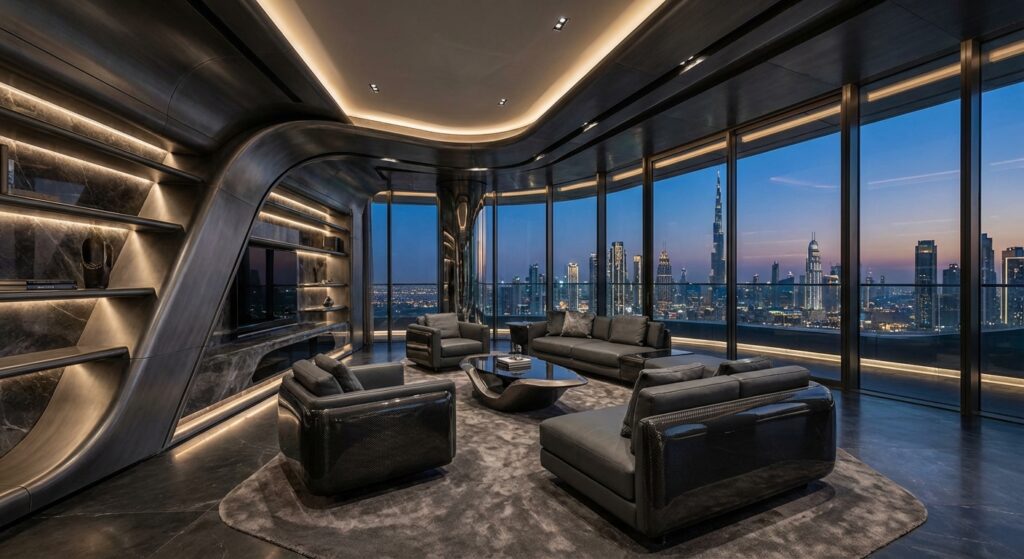
The translation requires architectural precision. Bentley Residences Miami incorporates diamond motifs from vehicle interiors across the 63-story facade and amenity spaces. Bugatti Residences Dubai features private car elevators delivering vehicles directly to penthouses. Fendi Casa collaborations ensure that textile selections and material finishes meet the fashion house’s standards rather than generic luxury specifications. Solomia Home operates within this translation process by sourcing furniture and finishes, maintaining brand integrity through established relationships with Italian manufacturers capable of custom finishes, bespoke dimensions, and material substitutions, matching brand requirements.
Lifestyle-Integrated Living
Lifestyle-integrated living refers to residential environments where services, amenities, and operational systems embed the brand identity into daily routines. Traditional luxury residences provide high-quality finishes and standard amenities. Lifestyle-integrated developments extend beyond basics to create environments where brand philosophy permeates operational details. Residents in Mandarin Oriental properties access spa treatments using brand-specific protocols, dine at restaurants featuring brand-curated menus, and receive services delivered in accordance with hospitality standards developed across the hotel portfolio.
Automotive-branded residences demonstrate integration through material selections and spatial design. Bentley Residences Miami infuses common areas with a synthetic automotive scent matching new vehicle interiors. Porsche Design Tower features Dezervator car lifts, allowing owners to park their vehicles inside their apartments. Service delivery models vary between hotel-operated and non-hotel branded properties. Hotel brands maintain operational control through management agreements, in which brand employees deliver services that meet hotel standards, while automotive and fashion brands typically license design rights and outsource operations to specialized residential management firms.
Market Structure and Development Pipeline
The branded residence sector expanded from 323 schemes in 2015 to 910 operational developments by 2025, with 837 additional projects contracted through 2032. This growth trajectory suggests total inventory reaching 1,747 schemes globally within six years, spanning 90 countries, with 25 nations launching inaugural branded residential projects in 2024-2025.
Regional dynamics shifted dramatically over five years. Asia Pacific inventory grew 55%, driven by Vietnam, Thailand, and India. The Middle East and North Africa saw 187% growth, led by Dubai’s aggressive development strategy. The city maintains 64 completed projects and 87 in the pipeline, making it the global capital of branded residences, ahead of Miami’s 48 completed and 55 in the pipeline.
| City/Market | Completed Projects | Pipeline Projects | Total Units | Dominant Brand Categories |
|---|---|---|---|---|
| Dubai | 64 | 87 | 13,000+ | Hotel, Automotive, Fashion |
| Miami/Fort Lauderdale | 48 | 55 | 8,500+ | Hotel, Automotive, Fashion |
| New York | 32 | 18 | 4,200+ | Hotel-dominant |
| Cairo | 2 | 26 | 3,800+ | Hotel, Mixed |
| Phuket | 12 | 14 | 2,100+ | Hotel, Resort |
Hotel brands maintain a 79% global market share. Marriott International leads with the largest portfolio across the Ritz-Carlton, St. Regis, and W Hotels brands. Non-hotel brand expansion accelerated through automotive and fashion categories. Automotive designer Pininfarina operates the fastest-growing portfolio with 30 projects, representing 650% network expansion. Financial performance metrics support continued expansion. Projects regularly achieve 50% pre-sales before official launch announcements. Four Seasons residential division generated $1.2 billion gross sales value in the first half of 2024 alone.
Furnishing and Interior Specification Requirements
Branded residence interiors require furniture and finishes that meet specifications far exceeding those of standard luxury residential projects. Brand licensing agreements typically include design approval processes where automotive or fashion design teams review all material selections to ensure alignment with brand aesthetics and quality standards.
Bentley projects demand furniture incorporating diamond patterns, specific leather grades, and metal finishes matching automotive interiors. Bugatti developments require components that complement hypercar aesthetics, where carbon fiber, aluminum, and exotic materials define the visual vocabulary. Fendi collaborations require textile selections, color palettes, and furniture silhouettes that reflect the fashion house’s collections. Generic luxury furniture manufacturers often cannot satisfy these requirements because standard high-end residential furniture lines lack the material precision that branded projects demand.
Solomia Home addresses these challenges through established relationships with Italian furniture manufacturers that produce pieces to the required specification levels. The firm maintains catalogs from manufacturers capable of custom finishes, bespoke dimensions, and material substitutions, matching brand requirements. The interior specification process follows established protocols, in which brand design teams provide material palettes during the development phase. Developers engage furnishing specialists like Solomia Home to translate requirements into actual furniture selections, coordinate with manufacturers on customizations, manage delivery logistics, and ensure installation meets brand standards.
Turnkey delivery represents a crucial advantage in the branded residence context. Projects sell as fully furnished units, with buyers receiving completed residences ready for immediate occupancy. Branded residence furniture budgets per unit can exceed $200,000-$500,000 for mid-tier units and reach $1-$2 million for penthouses, reflecting both specification requirements and brand premium expectations.
Secondary Market Performance
Secondary-market performance for branded residences demonstrates price resilience that exceeds that of non-branded luxury properties across market cycles. Data from Knight Frank and Savills shows branded properties maintain value during downturns while achieving superior appreciation during growth periods. Four Seasons residences globally demonstrated 20-25% resale gains over holding periods, while Atlantis The Royal Residences in Dubai achieved 194% premiums in secondary transactions.
Liquidity in branded residential secondary markets exceeds that of non-branded properties because brand recognition attracts international buyers beyond local markets. Four Seasons or Ritz-Carlton properties in Miami draw inquiries from Asian, European, and Middle Eastern buyers familiar with the brands through global exposure. Rental markets for branded residences yield 6-8% in Dubai and Miami, compared to 4-5% for comparable non-branded stock. Properties participate in hotel rental programs where professional management handles bookings, guest services, and maintenance.
Development Trajectories Through 2030
Branded residence sector projections indicate continued expansion through 2030, with total schemes expected to exceed 1,500 globally, according to Knight Frank data. Growth will concentrate in the Asia Pacific and Middle East regions, where the expansion of the UHNWI population and favorable regulatory environments support development activity. Non-hotel brand participation will increase as automotive, fashion, and lifestyle companies recognize residential real estate as brand extension opportunities, offering revenue diversification without manufacturing capital requirements.
Development models will continue shifting toward standalone residences without hotel components as brands gain confidence in residential-only operations. Sustainability integration will become a standard expectation. Younger UHNWI buyers demonstrate stronger environmental consciousness, with Gen Z and Millennial affluent individuals prioritizing ESG factors in investment decisions. Pricing premiums may compress in mature markets as supply increases. As markets saturate with multiple branded options, buyers will differentiate based on specific brand attributes, operational quality, and location.
For firms like Solomia Home operating in the interior furnishings sector, growth trajectories suggest expanding into new markets and brand categories. As automotive and fashion brands enter residential development, demand increases for furnishing specialists who can translate brand aesthetics into residential interiors while maintaining specification precision. The transformation of luxury housing through brand integration represents a fundamental shift in how ultra-wealthy individuals approach residential real estate, creating market structures where buyers willingly pay 30-50% premiums for brand association, service delivery, and operational consistency that non-branded properties cannot replicate.